Build or Buy an AI Voice Agent? How to Decide
Most businesses should start with a voice AI platform. Here is when building your own makes sense, and what we learned building the Verbex console.
By MD. Saifur RahmanPublished 9 min read
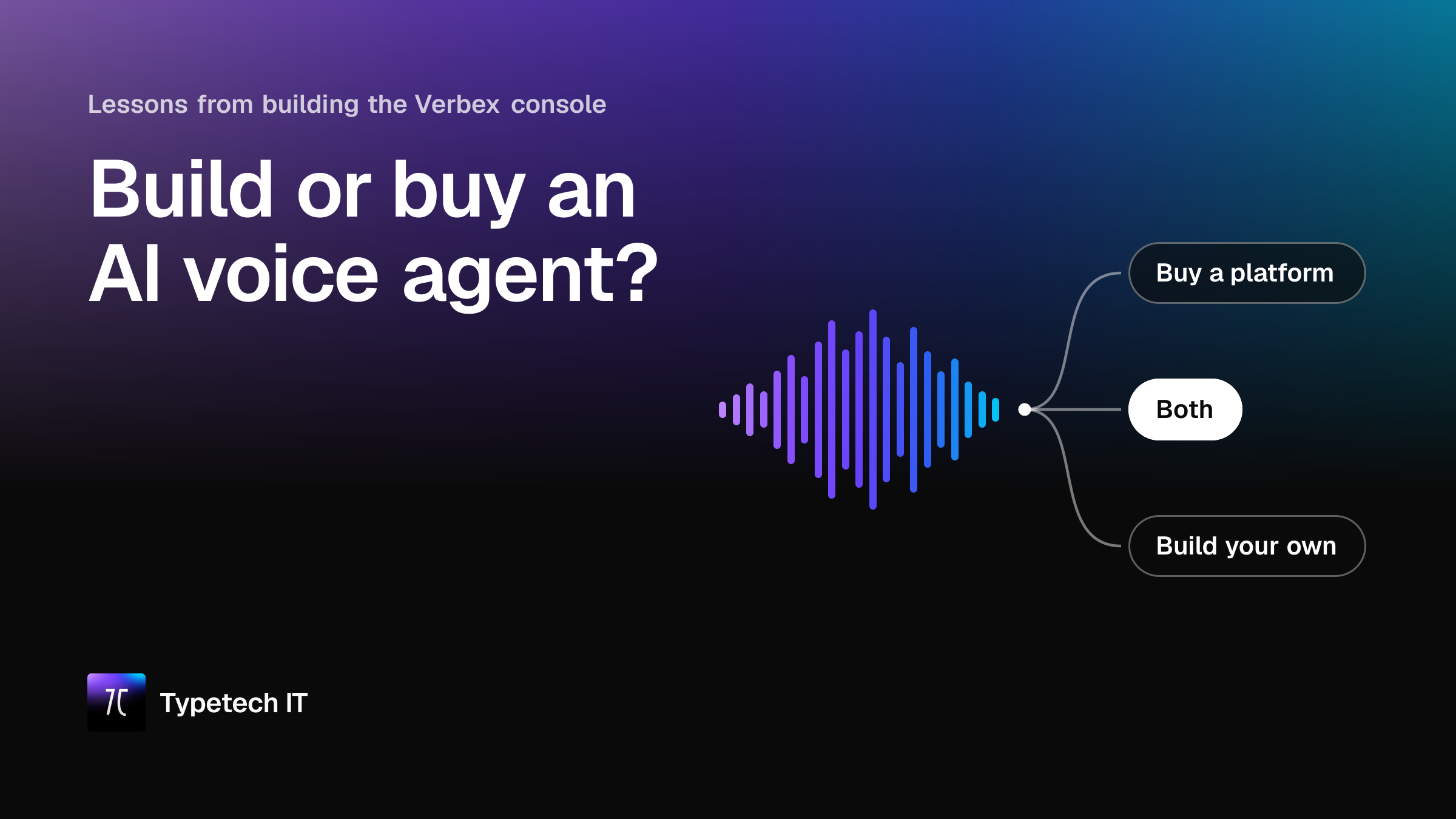
Short answer for founders and sales or support leads: Start with a voice AI platform to test AI calls quickly. Build your own when the calls are your product, or no platform fits your language, data or process. Most growing teams do both.
This guide compares the three paths: buy, build, or both. We share what we learned when we built the console for Verbex, a voice AI company in Dhaka, Bangladesh.
You will find a side-by-side view, the things that drive cost, and five questions to ask before you spend money.
What is an AI voice agent?
An AI voice agent is software that talks with people on the phone or on the web. It listens, understands the request and answers out loud. It can also act, for example book a meeting or update a record.
Most voice agents join four parts:
- Speech-to-text turns the caller's words into text while they talk.
- An LLM (large language model) decides what to say and what to do next.
- Text-to-speech turns the answer back into a voice.
- A phone line or web call connects the agent to the caller.
An AI SDR (sales development rep) is a voice agent with one job. It calls leads, answers their questions and books meetings for your sales team.
What do "build" and "buy" mean here?
Buy means you sign up for a voice AI platform. You write the agent's instructions, add your information and connect a phone number. You usually pay a monthly fee, a price for each minute of calls, or both.
Build means you make your own software around the voice parts. You still use outside services for speech and language models. But you own the screens, the rules, the data and the code.
Both is the most common path. A team uses a voice engine it does not own, and builds the parts that make its business different. The Salesgear guide (opens in a new tab) and the Apollo guide (opens in a new tab) describe the same three choices.
Verbex itself works this way. It combines its own speech models with outside LLMs (opens in a new tab). Each client picks a model for speed, security or cost.
When should you buy a platform?
Buy first if most of these are true for you:
- You want to test whether customers accept AI calls before you spend more.
- Your calls follow a simple script, such as reminders, bookings or common questions.
- Your callers speak a language the platform already supports well.
- Your team has no developers to run and fix software.
- Your call volume is still small.
A platform lets you learn what callers ask and where the agent fails. That knowledge is useful later, even if you build your own.
When should you build your own?
Building makes sense when one or more of these is true:
- The calls are your product. You sell AI calling to other companies, as Verbex does. Then you need your own accounts, billing and brand.
- No platform fits your language. Bangla, or a mix of languages in one call, may need special work.
- Your data must stay under your rules. For example, a bank or a hospital may need to control where call records live.
- The agent must work deep inside your own systems. It may need to read stock, change orders or follow approval steps.
- Your team needs its own tools. For example, a builder where staff change the agent without help from developers.
If none of these is true, building is usually more work than you need.
Build, buy or both: a side-by-side view
Question | Buy a platform | Build your own | Both |
|---|---|---|---|
How fast is the first call? | Fastest. The voice parts are ready | Slowest. You build screens and rules too | In between |
What do you pay up front? | Little or nothing | The most | Less than a full build |
What do you pay each month? | Platform fees and a price per minute | Your own hosting and the outside services | Engine fees plus your hosting |
How much control do you have? | What the platform allows | Full control | Full control of your own parts |
Who owns the code? | The platform | You | You own your parts |
Who fixes problems? | The platform's support team | Your team or your partner | Both, each for its own parts |
Best for | Testing the idea, simple scripts | Companies whose product is the calls | Most growing companies |
What we learned building the Verbex console
Verbex (opens in a new tab), earlier called Hishab, builds voice AI for call centers, hospitals, banks and other businesses in Bangladesh and Japan. Its own team built Bangla voice technology from the start, because no open Bangla voice models existed then.
Verbex asked us to design and build its website and customer console. We worked with the Verbex AI team from August 2024 to July 2025, in 5 milestones.
In the console, Verbex's customers create, test and run their AI voice agents. You can read the full Verbex case study. These are the lessons we would share with anyone who plans to build.
1. Let customers bring their own model
The console works with Verbex's own AI models, including Priya, its Bangla model. Customers can also connect their own models.
This is the "both" path from above. Plan for more than one model from the start, because models change quickly.
2. Your staff must be able to change the agent
Teams change their call scripts often. If each change needs a developer, the agent falls behind.
We built a visual workflow builder with React Flow. A team plans each step of a conversation without code.
3. Test in the browser before you call real people
A bad first call can lose a customer. The console lets a team talk to its agent in the browser before it calls anyone.
We used LiveKit for live audio and built a JavaScript SDK for voice calls in the browser. The team finds mistakes before a real caller hears them.
4. The agent is only as good as its knowledge base
An agent cannot answer what it does not know. Each team adds its own information to a knowledge base, and the agent answers from it. Plan who keeps this information up to date.
5. Decide what each call should collect
Customers choose what information their agents collect during calls. The console then shows that information in reports, next to the call logs.
Start with the questions your business needs answered, such as "Did the caller book a visit?" Then make the agent collect exactly that.
6. Phone numbers, payments and access are real work
Voice is the exciting part, but a product needs much more. Customers buy and connect phone numbers, and deploy agents for incoming and outgoing calls. We also added payments with Stripe and SSLCommerz, and API management.
In October 2026, Verbex signed an agreement (opens in a new tab) with the ICT Division of the Government of Bangladesh. Together they will study Bangla voice and text AI for public services, farming and small businesses.
What drives the cost?
An AI voice agent has two bills. The first is the cost to set it up or build it. The second is the cost to run it every month, mostly a price for each minute of calls.
Each minute can include the phone line, speech-to-text, the language model and text-to-speech. Published estimates differ a lot.
A Techsy review (opens in a new tab) found that the full price per minute is often higher than the advertised one. Some parts are listed separately.
These things change the price the most:
- How many tasks the agent does, and how many conversation steps it has
- How many languages it speaks
- Which systems it connects to, such as your CRM (customer relationship management system)
- How many calls it makes each month
- Rules for your industry, such as health or finance
- Whether you need accounts, billing and tools for many customers
When you compare offers, ask each company for both bills, line by line.
Five questions to ask before you decide
- What exact job will the agent do? Write down one task, such as "confirm tomorrow's appointments."
- Who are the callers, and which languages do they speak?
- Which systems must the agent read from or write to?
- How many calls do you expect each month, now and in a year?
- Are the calls part of what you sell? If yes, you will likely need to build.
If your answers are short and simple, start with a platform. If they are long, talk to a team that builds AI agents.
Questions people ask
How long does it take to build a custom AI voice agent?
It depends on how much you build. A platform is faster to start, because the voice parts are ready.
A custom product takes longer, because you also build accounts, billing and tools for your team. We give you a time range after a free call.
Can an AI voice agent speak Bangla?
Yes. The Verbex AI team built Priya, its own Bangla model, and Verbex also serves clients in Japan. Test each language with real speakers before you go live.
Can the agent pass a call to a person?
Yes. A good agent knows when to stop. Verbex calls this manned handover (opens in a new tab): the agent sums up the call and passes hard cases to a person.
Should callers know they are talking to AI?
We suggest you tell callers at the start of the call. Some countries have rules for automated calls. Check the rules in each country you call.
Who owns the code if you build with us?
You do. You own 100 % of the custom source code and intellectual property once the project is fully paid. We also sign a mutual NDA (non-disclosure agreement) before we start, if you ask.
Not sure which path fits you?
Tell us what your agent should do. We will tell you honestly whether to buy, build or do both. The call is free and takes 30 minutes on Google Meet.
If you build with us, you see a demo every week and reach us on WhatsApp between demos. After launch, you get 30 days of free bug fixing for the work we delivered.
Book a free 30-minute call (opens in a new tab)
Sources
- The Business Standard, "The voice of possibility: How Verbex.ai is giving AI a Bangladeshi accent (opens in a new tab)", May 2025
- Hishab and Verbex on Facebook, the agreement with the ICT Division (opens in a new tab), October 2026
- Salesgear, "The AI SDR Stack in 2026: Build It Yourself or Buy It? (opens in a new tab)", July 2026
- Apollo, "Build, Buy, or Blend: How Mid-Market B2B Companies Decide on AI SDR Capability in 2026 (opens in a new tab)", April 2026
- Techsy, "Build vs Buy AI Voice Agent: A 2026 Decision Framework (opens in a new tab)", updated October 2026
About the author

MD. Saifur Rahman
Co-Founder and CTO
MD. Saifur Rahman co-founded Typetech IT in 2023. As CTO (chief technology officer), Saifur leads our engineers and chooses the technology for each project.